

Ringkasan:
● Human flourishing menjadi kerangka lintas disiplin untuk perdamaian, kesejahteraan, dan depolarisasi global.
● ICRS berpartisipasi aktif dalam diskursus internasional melalui simposium di Australian Catholic University.
● Simposium menghasilkan kolaborasi konkret Indonesia–Australia dalam riset, pendidikan, dan pengembangan akademik.
Oleh: Imanuel Geovasky | Republikasi dari ICRS
Human flourishing has gained increasing attention in global academic and policy-oriented discussions as scholars seek more comprehensive frameworks for understanding human development, peace, and social cohesion in an era marked by polarization, social fragmentation, and global uncertainty. Rather than being confined to a single discipline, the concept has become a meeting point for research in philosophy, education, religious studies, psychology, and the social sciences, encouraging dialogue across cultural and national boundaries. This growing interdisciplinary and international interest has been expressed through various scholarly forums and collaborative initiatives designed to foster cross-regional exchange and cross-cultural academic engagement on human flourishing, providing the context for Indonesian scholars to participate in international discussions.
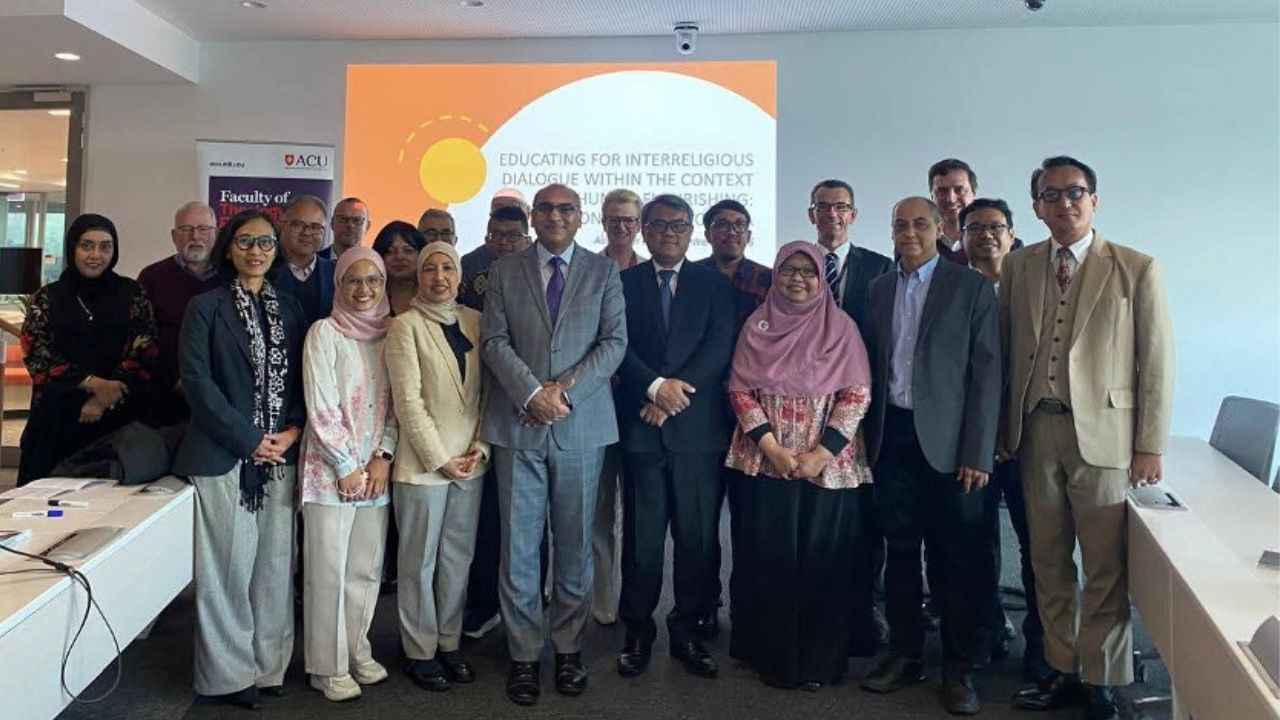
A delegation from the Indonesian Consortium for Religious Studies (ICRS), consisting of Dr. Zainal Abidin Bagir, Prof. Dr. Fatimah Husein, Dr. Dicky Sofjan, and three Ph.D. students, Fardan Mahmudatul Imamah, Fuji Riang Prastowo, and Imanuel Geovasky, attended a symposium entitled ‘Flourishing, Peace, and Depolarization’ at the Australian Catholic University (ACU), Melbourne Campus, on 1–2 December 2025. This symposium discussed a topic that is currently widely debated in academic circles in Australia and beyond: human flourishing. While the idea is relatively new in Indonesian academic contexts, it has been the focus of extensive research at several prestigious international institutions, including Harvard University’s Human Flourishing Program, the University of Nottingham’s Centre for Research in Human Flourishing, Baylor University’s Institute for Global Human Flourishing, and the multi-year Global Flourishing Study (GFS), a collaborative project involving Harvard, Baylor, Gallup, and the Centre for Open Science.
Human flourishing encompasses six key domains: happiness and life satisfaction, mental and physical health, meaning and purpose, character and virtue, close social relationships, and financial and material stability. At ACU, the concept is embedded within the university’s vision, reflecting its commitment to fostering holistic well-being. On another occasion, Professor Abid Khan, Vice Chancellor of ACU, highlighted the potential for developing a consortium of Australian and Indonesian universities to share knowledge and practices among Indigenous communities and religious groups, contributing perspectives from the Global South to international dialogues on human development. This demonstrates that human flourishing is not only a theoretical concept but also a strategic area for research, particularly in the context of Indonesia and the broader global landscape.
The two-day symposium began with a welcome address by Professor Andrew O’Neil, Dean of Graduate Research and International Studies at ACU, who introduced the symposium’s central theme. This was followed by remarks from His Excellency Yohannes Jatmiko Heru Prasetyo, Consul General of the Republic of Indonesia in Melbourne, who emphasized the growing strategic relationship between Indonesia and Australia and highlighted the positive impact of collaboration on human flourishing across governments, universities, schools, and communities.
The first session focused on education, religious literacy, and the fundamentals of religious teachings that promote peace, with presentations by Prof. Fatimah Husein, Dr. Emmanuel Nathan (ACU), and Prof. Ismael Albakek (ACU), chaired by Prof. Michael Champion. Education was highlighted as both the gateway and foundation for achieving human flourishing. The second session examined religion in relation to green Islam in Indonesia, polarization, holy violence, and secular extremism, featuring presentations by Dr. Zainal Abidin Bagir, Dr. Dicky Sofjan, and Assoc. Prof. Joel Hodge (ACU), chaired by Prof. Fatimah Husein. This session provided a broader perspective on the challenges to human flourishing in both Australia and Indonesia.
The third session offered Ph.D. students the opportunity to present part of their thesis research. Imanuel Geovasky presented “Pedagogical Methods and Peace Education’s Impact on the Empathy Dimension of Tolerance for Human Flourishing,” followed by Fardan Mahmudatul Imamah with “Between Myth and Modernity: Negotiating Agrarian Beliefs under State Policies and Global Economic Pressures in Indonesia,” and Fuji Riang Prastowo with “Cultural Spirituality and the Aftermath of Bureaucratic Disappearance: Post-New Order Buddhist Heritage in Rural Java.” Professors provided feedback and constructive questions to enhance the students’ analyses and research insights.
The second day of the symposium centered on collaborative initiatives between ACU and ICRS, including the Indonesia–Australia Human Flourishing Project, frameworks for joint Ph.D. and Masters programs, and other academic partnerships. During this session, ACU and UIN Sunan Kalijaga signed a Memorandum of Understanding, and ACU and UGM finalized a Joint Ph.D. Agreement. These agreements were signed by Prof. Abid Khan, Dr. Zainal Abidin Bagir, and Prof. Fatimah Husein, with H.E. Yohannes Jatmiko Heru Prasetyo as a witness.
Overall, the symposium was dynamic and productive. Beyond establishing formal collaborations, it provided significant benefits for the attending Ph.D. students, expanding their knowledge on human flourishing and allowing them to interact with leading scholars. Their participation not only enhanced their academic perspectives but also positioned them to contribute meaningfully to the emerging discourse on human development, peace, and well-being in Indonesia and internationally.
Editor: Andrianor