

Ringkasan:
● Konferensi AASR 2025 menyoroti hubungan antara etika ekologi, ruang sakral, dan ketangguhan spiritual masyarakat lokal.
● Delegasi ICRS UGM memaparkan riset mendalam mengenai dinamika agama pedesaan di konferensi AASR 2025.
● Penelitian Indonesia menunjukkan adaptasi kreatif komunitas dalam menjaga tradisi di tengah arus modernisasi global.
Republikasi dari ICRS
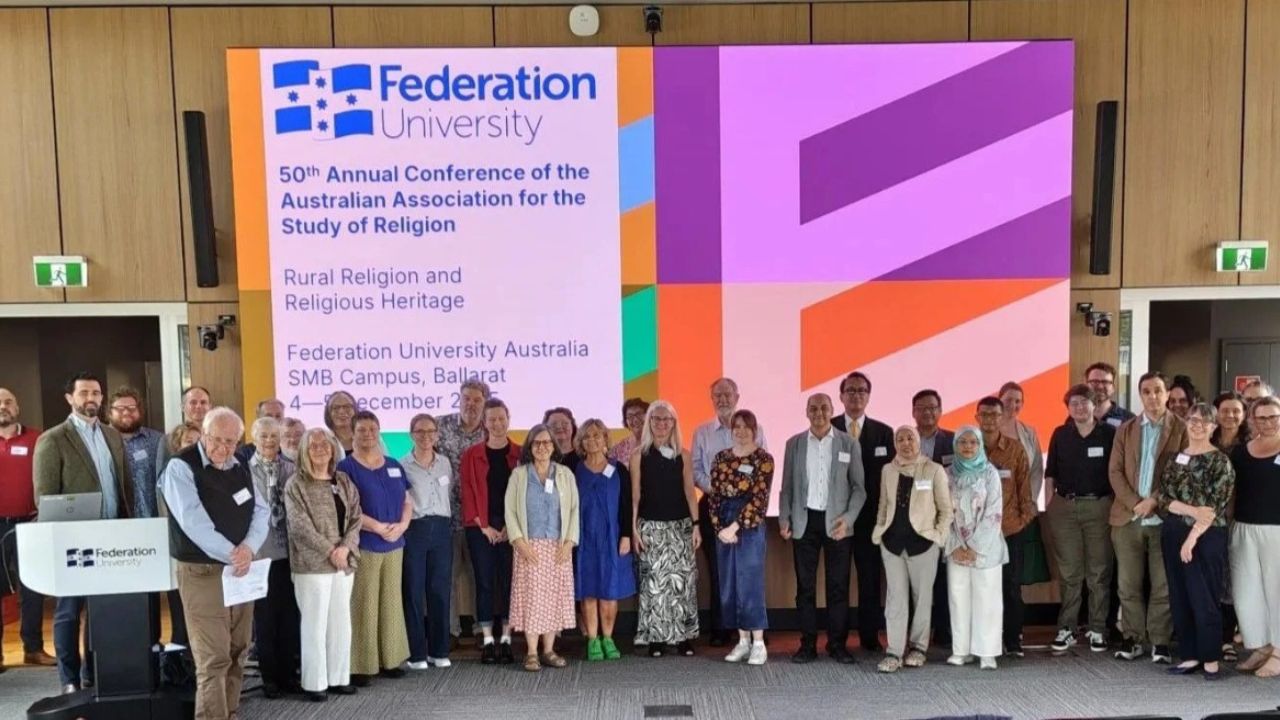
The recent 50th Annual Conference of the Australian Association for the Study of Religion (AASR), held at Federation University in Ballarat from December 4 to 5, 2025, served as a vibrant intellectual crossroads for scholars examining the nuanced tapestry of “Rural Religion and Religious Heritage.” This landmark event provided a crucial platform for examining how faith, tradition, and spirituality manifest and adapt in rural landscapes, shaped by nature, community, and often profound change. Demonstrating its active role in global scholarly conversations, the Indonesian Consortium for Religious Studies (ICRS) at Universitas Gadjah Mada fielded a robust delegation to this prestigious forum. The team, comprising esteemed faculty members and three dynamic doctoral candidates, presented a compelling suite of research rooted in the Indonesian context, thereby enriching the conference’s thematic scope and underscoring ICRS’s leadership in innovative, field-driven religious studies.
The conference was intellectually framed by two thought-provoking keynote lectures that set the tone for discussions on lived religion, ecology, and the transcendence of binary thinking. The opening keynote was delivered by Professor Lori G. Beaman, the Canada Research Chair in Religious Diversity and Social Change from the University of Ottawa. Her presentation drew from her extensive research project to propose community gardens as fascinating “refraction points” for understanding contemporary ethics, relationships, and ways of being in the world. Moving beyond simplistic categorizations, she argued for a “beyond the binary” approach to comprehending religion and nonreligion. Through her analysis, gardens emerged not merely as plots of land but as social spaces where concepts of stewardship, wellness, healing, and relationality are actively cultivated. These spaces, she illustrated, often host a complex interplay of motivations—political, social, spiritual, and material—that challenge clear-cut religious or secular labels. Her insights into horizontal relational ethics and the “will to religion” provided a powerful theoretical lens that resonated with many case studies presented at the conference, including those from the ICRS team.
The second keynote, the Penny Magee Memorial Lecture, was delivered by Professor Clara Saraiva from the University of Lisbon. Her presentation transported attendees to Sintra—a UNESCO Cultural Landscape revered as a sacred, “enchanted” mountain. Professor Saraiva painted a vivid picture of Sintra as a unique geographic and spiritual magnet, a rural refuge from urban chaos that attracts a breathtaking diversity of seekers. From historic monastic orders to neo-druids, neo-shamans, and various holistic practitioners, Sintra exemplifies “spiritual elasticity” and “transreligiosity.” She described how the mountain’s natural energy and romantic reputation are harnessed by individuals and groups to address personal crises and collective “eco-anxiety,” fostering a convergence of vernacular traditions and global spiritual trends. This focus on sacred geography, ecological spirituality, and the blending of traditions in a rural setting perfectly complemented the conference theme and echoed the explorations of place-based belief systems presented by ICRS researchers.
Within this stimulating global dialogue, the ICRS scholars presented nuanced studies from Indonesia, each contributing unique empirical depth to the themes of rural religion, heritage, and adaptation. Doctoral candidate Fuji Riang Prastowo presented findings from immersive fieldwork in the isolated regions of Gunungkidul and Kulonprogo. His research investigated the dramatic demographic shifts within Javanese Buddhist communities, framing it not as a simple disappearance but as a strategic reconfiguration into localized, cultural spirituality. He documented how traditions have been resiliently woven into the fabric of Javanese cosmology and Buddhism-Javanese village rituals, showcasing the adaptive mechanisms of marginalized communities in preserving their heritage amidst bureaucratic challenges.
Fellow doctoral researcher Imanuel Geovasky shifted the focus to pedagogy and social cohesion within Indonesia’s pluralistic landscape. Employing rigorous quantitative methods, his analysis of survey data from students across different faith-based universities yielded a significant finding: peace education has its strongest impact on fostering empathy. This result powerfully underscores the critical role of affective, experiential learning in building the relational foundations for genuine tolerance. His work argues that cultivating such empathy is essential for recognizing the inherent dignity of others, thereby contributing to reconciliation and holistic societal peace.
The third doctoral presenter, Fardan Mahmudatul Imamah, delved into the intricate intersection of agrarian life, ancestral belief, and modern pressures. Through meticulous long-term observation in a Yogyakarta farming hamlet, her research revealed that agrarian myths and rituals are far from obsolete. Instead, they function as a vital “moral economy” and a dynamic framework for negotiation. Farmers navigate the competing demands of state agricultural policies, global market forces, and economic necessity while maintaining practices that honor sacred geography and ancestral covenants. Her work demonstrates how religion operates as an active space for negotiation, allowing communities to maintain ethical harmony with their land and heritage amidst relentless change.
Adding senior scholarly weight to the delegation, Dr. Zainal Abidin Bagir presented a critical analytical reflection on the “Green Islam” movement in Indonesia. Offering a seasoned assessment that built upon decades of scholarly debate, he advocated for a more grounded and impactful perspective. He called for a greater focus on environmental actions deeply rooted in lived religious practice—those that are community-based and respond to local ecological crises—and, crucially, those that integrally link environmental stewardship with questions of social and environmental justice. His presentation served as a crucial theoretical and ethical anchor, emphasizing that the depth and effectiveness of religious environmentalism must be measured by its tangible impact on both ecosystems and human dignity.
The active and multifaceted participation of the ICRS delegation at the AASR conference signifies more than just the dissemination of research findings. It represents a meaningful and sophisticated contribution to global theoretical debates on the nature of religion, spirituality, and community in the contemporary world. By engaging deeply with the keynote themes—such as post-binary analysis, lived ethics, sacred geography, and ecological spirituality—the Indonesian scholars demonstrated the global relevance of localized, context-rich studies. Their collective work vividly illustrates that rural religious heritage is not a static relic but a dynamic field characterized by resilience, creativity, and continuous negotiation.
Editor: Andrianor