

Ringkasan:
● Pendidikan agama rentan tersusupi ideologi eksklusif dan misoginis dari luar akibat metode kolonial dogmatis.
● Media sosial dan doktrin luar memicu dominasi serta ketimpangan ruang dialog di dalam kelas.
● Dekolonisasi pendidikan melalui pendekatan dialogis dan prinsip Trikon mendesak diterapkan demi keberagaman.
Oleh: Afkar Aristoteles Mukhaer | Republikasi dari ICRS
No knowledge remains stagnant; it always evolves with the times. This is why the classroom is ideally a place for knowledge transfer and development through dialogue and discussion. The same applies to religious education, which is crucial for students’ character formation and moral foundation, and whose discussions remain relevant to the issues of every era.
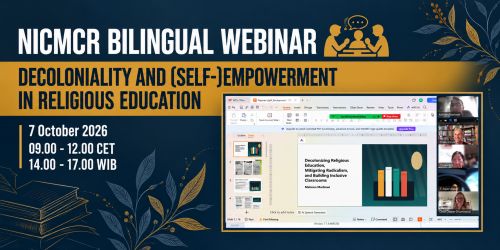
However, education is often a space marked by imbalanced power relations between teachers and students, and among students. This imbalance turns classroom dialogue into an arena for defending knowledge and doctrine. The Netherlands-Indonesia Consortium for Muslim-Christian Relations (NICMCR) Education and Religion Working Group discussed religious education through two case studies on Wednesday, October 7, 2026.
Infiltration of Exclusivist Ideology into Religious Education in Indonesia
Religious education is part of Indonesia’s national curriculum. However, Mahnan Marbawi, an education practitioner and academic, highlights that it is designed to enable teachers to “deliver doctrinal content,” which reinforces exclusivist religious ideology. He drew this reflection from his observations of Islamic Religious Education (PAI) classes at the secondary school level.
One class Marbawi observed discussed the relationship between the state and religion. A student responded that “Pancasila is thagut (satanic thinking) and Indonesia is an infidel state that does not recognize God.” The teacher emphasized that Pancasila and Indonesia align with the principles of all religions, including Islam.
Marbawi also analyzed several student notes that displayed exclusivist Islamic views. All the students expressing these views were male. Such views clearly do not originate entirely from classroom materials, and their infiltration, along with that of radical religious ideology, also occurs in non-religious public schools. Marbawi argues that it originates outside the classroom, in external organizational activities, recruitment by exclusivist group networks, social environments, and access to reading materials. Students, meanwhile, are at a crucial stage of searching for identity and self-worth.
From the dialogue between teachers and students, Marbawi noted that the classroom plays a role in indoctrination, in this case about nationalism. In other cases he encountered, however, Islamic Religious Education teachers tended to be authoritarian rather than promoting diversity. Some mentors, especially those from religious education institutions outside school, supported the indoctrination of exclusivist ideologies and instilled prejudice against different groups. Some tutors even omitted verses of the Quran and Hadith, or used them selectively, to justify their views.
Marbawi attributed this to the authoritarian instructional methods inherited from the colonial education system. Teachers and tutors positioned themselves as the only ones who were right and dictated dogma without allowing students space for critical thinking. As a result, the core of religious subjects was considered taboo for open discussion, fostering an institutional fear that discouraged students from asking questions.
For Marbawi, religious education should function as a “cultural womb” that produces a generation that is religious, critical, and respectful of Indonesia’s diversity. He suggested decolonizing religious education through Ki Hadjar Dewantara’s Trikon principle (continuous, convergent, and concentric). Religious education needs to be continuous, open to various sources, and rooted in personal values.
When Dutch Manosphere Nuances Enter Religious Education
In the Netherlands, outside perspectives also infiltrate religious classrooms. Pauline Kraakman, an education practitioner and teacher at Emmaus College in Rotterdam, found that some of the male students in her fifth-year pre-university (VWO) class held misogynistic views during a discussion on Religion/Worldview.
The class discussed gender, beginning with a presentation by two students on Simone de Beauvoir’s thought, including her famous statement: “One is not born, but rather becomes, a woman.” The presentation then moved on to topics such as work, the division of labor, and family.
Kraakman said the class included three close male friends known as the “lively students.” They were Christian and stated that Jesus was important in their lives. In the gender discussion, they tried to win the argument with misogynistic views supported by religious narratives.
One student said, “A man has the responsibility to provide financially for his family, and that is why it is important for him to earn a good income. So, boys should be given every opportunity to study in order to get a good job later on, which will enable them to carry that major family responsibility.” Kraakman noticed that the female students remained silent, giving disapproving looks and glancing at each other.
A friend added, using biblical reasoning, “In the creation story, the division of roles is already clear: the woman was created as the man’s helper.” Another student asked rhetorically, “Besides, didn’t Jesus also choose only men for the important work of spreading his message?”
A vocal female student who took debate classes criticized this view. Yet one of the three male students snapped at her: “Then you’ll never be my wife!”
Kraakman said this male-dominated dynamic is reinforced by social media, especially TikTok, where influencers promote the manosphere. The manosphere is a phenomenon of patriarchal and anti-women’s-rights narratives that developed in response to feminism and to discussions of white male privilege in Europe.
This case underscores the need for educators to understand how narratives from outside the classroom, such as social media and traditional religious interpretations, can influence classroom interactions. It also shows that teachers’ most important task today is to train students to consider other perspectives. Without teacher sensitivity, the impact can extend to the school community and undermine the educational environment as a safe space for dialogue.
Decolonizing Religious Education in Indonesia and the Netherlands
Hannie Hoefnagels, a worldview/religion teacher and VDLG member, and Iwan Setiawan, an Islamic studies academic at UNISA Yogyakarta, responded to the two case studies. Both cases share a common feature: the environment outside the classroom influences students’ thinking. This makes the classroom what Hoefnagels, citing Hannah Arendt, calls an in-between space, into which students can naturally bring narratives such as extreme doctrines and the manosphere.
Setiawan argues that classroom dialogue is crucial to prevent communication deadlocks between teachers’ and students’ perspectives. Dialogue also discourages authoritarian or doctrinal teaching methods, which can foster rigid interpretations of religion among both teachers and students who receive lessons outside the classroom. Dialogical and critical approaches also address misunderstanding and rigidity in how religion is interpreted and taught, helping students develop a more inclusive religious perspective.
Hoefnagels highlighted the relationship between state and religion in the PAI lesson described by Marbawi. According to her, the case shows that classroom discussions encourage students to respond as Muslims rather than as citizens. Students could respond only with a piece of paper rather than engage in a two-way dialogue with the teacher, which makes it natural for them to incorporate exclusivist doctrines into their answers.
Anisa Eka Putri Kusmayani, one of the webinar participants, examined the reasons behind the rigid education system through the lens of historical psychology and family sociology. In her view, the colonial model of learning, in which teachers are always right and the sole authoritative source of knowledge, is a legacy that persists in Indonesian schools and a form of intergenerational trauma. Colonialism introduced a system of obedience to hierarchy, which postcolonial countries like Indonesia have since preserved as an important life strategy.
True dialogue requires a lively oral process in which participants actively listen to each other and rephrase one another’s arguments. She argued that rephrasing trains students to confirm their understanding and step into another’s shoes without being forced to agree immediately.
However, simply encouraging students to think critically is not enough to foster dialogue in decolonizing religious education. When classrooms face conflict, teachers and students experience acute somatic and emotional dysregulation. Decolonial education therefore requires reflective learning that connects critical thinking with inner conscience and teacher-student communication skills.
Religious education requires decolonization through a dialogical approach. Teachers need to be inquiry facilitators who foster a spirit of inquiry in the classroom. When students make harsh or radical statements, teachers should not respond with condemnation or confrontational denial but ask questions that stimulate critical thinking. This spirit of inquiry must be supported by clear boundaries: discussion may freely challenge ideas, but it cannot tolerate personal attacks or actions that demean other students.
In the Dutch context, Kusmayani argued that the current situation is rooted in a postcolonial reality. The Netherlands today faces the rise of conservative and right-wing politics, which should be understood as an intergenerational, reflexive defense: an attempt to exert dominance in order to preserve the status quo, manifested in the proliferation of narratives surrounding “white male privilege” and “old fascism.” Decolonizing religious education is therefore essential, as it helps teachers shed the inherited colonial reflexes that persist in both the Netherlands and Indonesia.
Another webinar participant, August Corneles Tamawiwy, offered an intriguing proposal for decolonizing religious education in both nations. According to Tamawiwy, Ki Hadjar Dewantara’s Trikon principles, emphasizing continuity, convergence, and concentricity, can be applied not only in Indonesia but also in the Netherlands and other Western countries to foster an inclusive and equitable approach to religious education. These principles support a sustainable perspective and highlight the interconnectedness of diverse societies in our cosmopolitan world. As such, the proposal represents a form of decolonization that elevates religious education from a local context to a global stage.
Editor: Andrianor